
Job vs AI
Human judgment first.
Pick a profession and see the work broken down to individual tasks, each one placed in a lane: automate, augment, human, or verify.
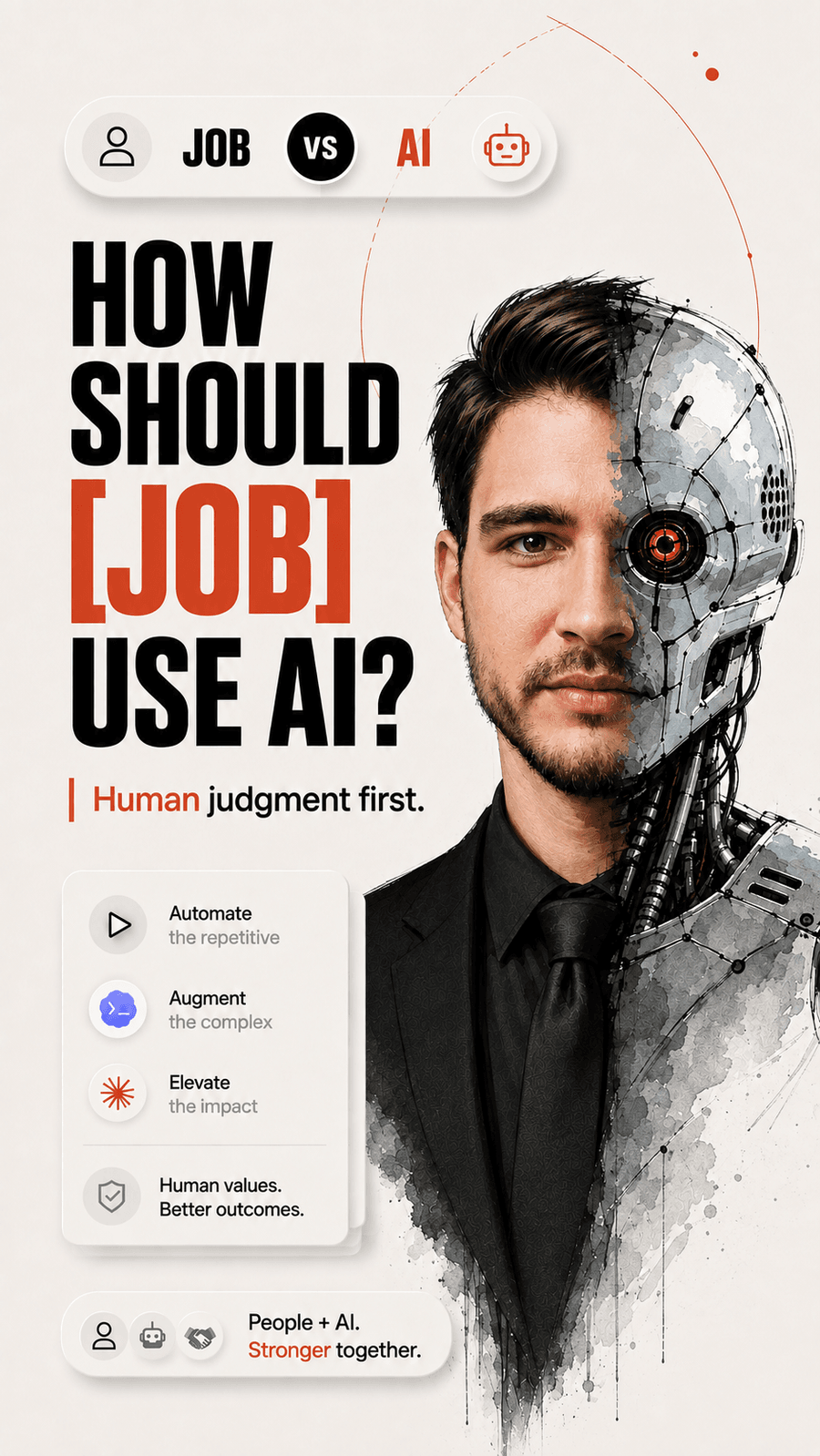
Every analysis answers the same question in the same order: what the profession actually does, which tasks are involved, and only then where AI belongs.
01The library
The library
Sales
Account Manager
The only profession in this series where a completely correct output can still be the thing that costs you the account.
Delivery
Project Manager
The profession whose actual deliverable is information other people act on - which makes it the one where faster reporting can quietly make the job worse.
Healthcare
Nurse
The profession where the honest answer is most often that technology should stay out of the way - and where the work it can take off you is worth more than anywhere else.
Finance
Accountant
Rule-bound work at volume, wrapped around judgment that a regulator assumes a person made. The first half automates well. The second half is the job.
Engineering
Mechanical engineer
Design, analysis and validation work where a wrong answer ends up in a physical object. The artefacts are getting cheaper to produce; deciding whether they are right is not.
02How to read a page
The four lanes
Every task on every profession page carries one of these. The lane is a judgment about who is accountable, not a rating of difficulty.
Automate
Repetitive, low-risk tasks
Is this rule-shaped, repeated often, and cheap to check when it goes wrong?
Augment
Analysis, drafting, research
Would a fast first draft or a wider search make the human better at this?
Human
Judgment, context, empathy
Does this need accountability, lived context, or a call someone must own?
Verify
Facts, risk, accountability
What has to be checked before this leaves the building?