
Job vs AI · Finance
Accountant
Rule-bound work at volume, wrapped around judgment that a regulator assumes a person made. The first half automates well. The second half is the job.
Most of what looks automatable in accounting was automatable before AI existed. Knowing which half you are looking at is the skill.
The problem
Start with the problem, not the tool
You already know accounting. The open question is where technology belongs in it.
Accounting attracts AI pitches because so much of the work looks repetitive from the outside. Some of it genuinely is. But the repetitive parts were automatable long before generative AI existed, and the parts that were not automatable are not automatable now for reasons that have nothing to do with model quality.
"Which of my tasks can AI do?" leads nowhere. It starts from a capability and hunts for a use. The question that works is narrower: at this specific step, what am I trying to accomplish, which part needs judgment, and what has to be checked?
Order matters. Problem, then workflow, then decision, then technology, then verification. In this profession the last step is often not yours to design - a standard, a regulator or the audit file has already specified it.
Lane 01
Automate
Rule-shaped work at volume. Accounting has more of this than most professions.
What belongs here
Transaction coding against a stable chart of accounts, matching invoices to orders and receipts within a stated tolerance, reconciliation matching, exception listing, and assembling reports from data that already exists.
What it still costs you
Writing the rules down, approving the treatment of each recurring counterparty, deciding what counts as an exception, and sampling the output against source documents. Automated output is never sign-off.
Why this rarely means generative AI
If the rule is stable and writable, conventional software applies it identically every time. A language model does not offer that guarantee, and reproducibility is exactly what a ledger needs.
Lane 02
Augment
A person still decides; the machine drafts, searches or organises.
What belongs here
Drafting management commentary from numbers you supply, researching candidate treatments for an unusual transaction, summarising working papers, and preparing forecast scenarios for you to weigh.
What stays yours
The causal claim. A model has the numbers, not the reason the plant was down for a week. Draft with it; never let it supply the cause of a variance.
Every citation is unchecked until you open it
Technical research is the shape of task that invites fabricated references: a specific paragraph number, quoted confidently, that does not say that. Use the tool to find candidates, then do the reading.
Lane 03
Human
Judgment under a code of ethics, and the name against the number.
What belongs here
The accounting treatment of a transaction the standards do not settle cleanly, materiality decisions, professional opinion, and anything an independence or ethics requirement constrains.
What AI can still do around it
Organise the facts, lay out the options and the precedent, model the effect of each treatment on the statements, and draft the question you take to someone more senior. None of that is the decision.
Lane 04
Verify
The check that makes the other three safe - and here, mostly one you did not design.
What belongs here
Reconciliation to source evidence, the audit trail, records retention, and the conclusion on whether evidence is sufficient and appropriate to support what is reported.
Imposed, not designed
In most professions you design the verification. Here the first move is to find out what is already required by standard, regulator or the file, and design inside it. Proposing a lighter check than the standard demands is not a trade-off; it is a defect.
What counts as evidence
Sufficiency is quantity; appropriateness is relevance and reliability. An AI assertion pointing at nothing you can open is not evidence, and ten AI summaries of one document are still one document.
Situations
Six situations, worked
Six representative situations, chosen to show different lane mixtures. The counts are of these six examples - not a measurement of the profession.
- 01Automate2examples
- 02Augment2examples
- 03Human1example
- 04Verify1example
Coding transactions to the chart of accounts
AutomatecontinuousStable rule, checkable output, and a solved problem long before generative AI. A rules engine, not a model.Reconciling a control account at month-end
AutomatemonthlyMatching is arithmetic against a stated tolerance. The judgment is in what the remaining differences mean.Explaining a variance for the management pack
AugmentmonthlyIt can assemble the movement and draft the wording. The causal claim stays with the person who knows the business.Researching the treatment of an unusual transaction
Augmentas requiredUseful for finding candidate standards. Every citation is unchecked until you open the paragraph yourself.Deciding materiality and the accounting treatment
Humanper judgmentA regulator assumes a person made this call, and no tool changes who that person is.Forming the conclusion on the financial statements
Verifyper reporting cycleAssembling and indexing the evidence is automatable. Deciding it is sufficient and appropriate is not.
Solutions
Choose the kind of solution, then the tool
Most accounting problems are not generative-AI problems. Naming the class is the decision.
Conventional software and integration
The rule is known and exact: coding, allocations, recurring journals, posting through an API.
For example: Xero Accounting API, QuickBooks Online API
Watch for: Asking a model to reproduce a rule you could write is the tell that you picked wrong.
Deterministic matching in the ERP
Compare invoice, order and receipt against a stated tolerance and hold what falls outside it.
For example: Dynamics 365 accounts payable matching
Watch for: Often a feature you already own and have not switched on.
Workflow automation
Move data between systems on a schedule, and chase what has not arrived.
For example: Power Automate and comparable tools
Watch for: Automating a broken process makes it fail faster, not better.
Generative AI
Language is the deliverable: drafting commentary, summarising papers, extracting from documents.
Watch for: It must never supply a cause or a citation you have not verified, and reproducibility is not on offer.
No technology at all
Treatment, materiality, opinion - and sometimes a process change, or deleting the step.
Watch for: Before automating a reconciliation, ask why it produces so many differences.
Chatbot → agent
From chatbot to agent
The same task at four levels of support. Most accounting work should stop at the second.
Ask a chatbot
You paste the variance table in and it drafts commentary. Genuinely useful, and where most people should start.
AugmentSave the prompt
The same instructions every month, so the output stops drifting. This is where most accounting tasks should stop.
AugmentGive it context and tools
It reads the ledger extract and last month's pack rather than whatever you remembered to paste in.
AugmentMake it an agent
Multi-step, branching on what it finds, with a fixed output contract and an explicit escalation. Worth it only when the task repeats, needs live access, and can be checked mechanically.
Verify
Blueprint
What an accounting agent looks like
One worked example, through the same ten components any profession would use. The playbook carries three.
Goal
Produce the exception list for one account and one period. Narrow enough that you can tell whether it succeeded.
Rules
Never adjust a figure. Never net off unexplained differences. Every exception cites both sides of the difference.
Tools
Ledger read-only, the bank or sub-ledger feed, and a matching function with a stated tolerance. Read-only is a design decision, not a limitation.
Memory
Recurring counterparties, known timing differences and prior-period explanations - the context you would otherwise re-supply every month.
Output contract
One row per exception: ID, both source rows, difference, age, proposed category, confidence. A fixed shape is what makes review mechanical instead of a re-read.
Verification
Every row opens to both source records, and the control account still has to reconcile in total. The check is the same one you already owe the file.
Escalation
Anything that would change a reported figure, and any difference it cannot categorise. An agent with no defined refusal will answer confidently in exactly the case where it should have stopped.
Risks
Where this goes wrong
The familiar failure modes, plus two that are professional-conduct matters before they are technology matters.
Fabricated citation
High riskA standard and paragraph number, quoted confidently, that does not say what the output claims it says.
What to do:Open every standard cited and read the paragraph. A reference you have not read is not a reference.
Invented cause
High riskA plausible explanation for a variance the model has no way of knowing the reason for.
What to do:Let the tool describe the movement and leave the cause blank. You supply causes.
Automation bias
High riskA fluent pack discourages the independent look that would have caught the error.
What to do:Match the strength of review to the consequence of being wrong, not to how convincing the output looks.
Confidentiality breach
High riskClient or employee data placed in a service your professional obligations do not permit - correctly processed, and still a breach.
What to do:Establish which tools you may put the data into before comparing what they can do.
Silent misclassification
Medium riskCoding that is wrong the same way across thousands of transactions, inside a process others rely on.
What to do:Sample against source documents and reconcile the control account; volume makes a small error rate expensive.
Sources
Research basis
What the profession framing and the risk principles rest on. The lane assignments above are Human AI Judgment analysis, not a classification made by any of these organisations.
- Accountants and Auditors (13-2011.00) (opens in a new tab)
O*NET OnLine
Occupational tasks and work activities. Used to structure the situations the lane assignments rest on.
- Accountants and Auditors (opens in a new tab)
U.S. Bureau of Labor Statistics
What the work is and its scale. Used to describe the profession, not to support any AI claim.
- ICAEW Code of Ethics (opens in a new tab)
ICAEW
Fundamental principles and independence. Underpins the confidentiality and accountability positions.
- AS 1105: Audit Evidence (opens in a new tab)
PCAOB
Sufficiency is quantity; appropriateness is relevance and reliability. The basis for the evidence framing.
- AS 2110: Identifying and Assessing Risks of Material Misstatement (opens in a new tab)
PCAOB
Risk assessment, which is what materiality judgments are made against.
- IAS 1 Presentation of Financial Statements (opens in a new tab)
IFRS Foundation
What the reported output has to contain.
- Artificial intelligence resources (opens in a new tab)
ICAEW
Profession-specific guidance on AI, including why professional scepticism is the skill that transfers.
- AI Risk Management Framework: Generative AI Profile (opens in a new tab)
NIST
Cross-sector guidance on generative-AI risk. Informs the failure modes above.
+Playbook
The full analysis, in a form you can take into work.
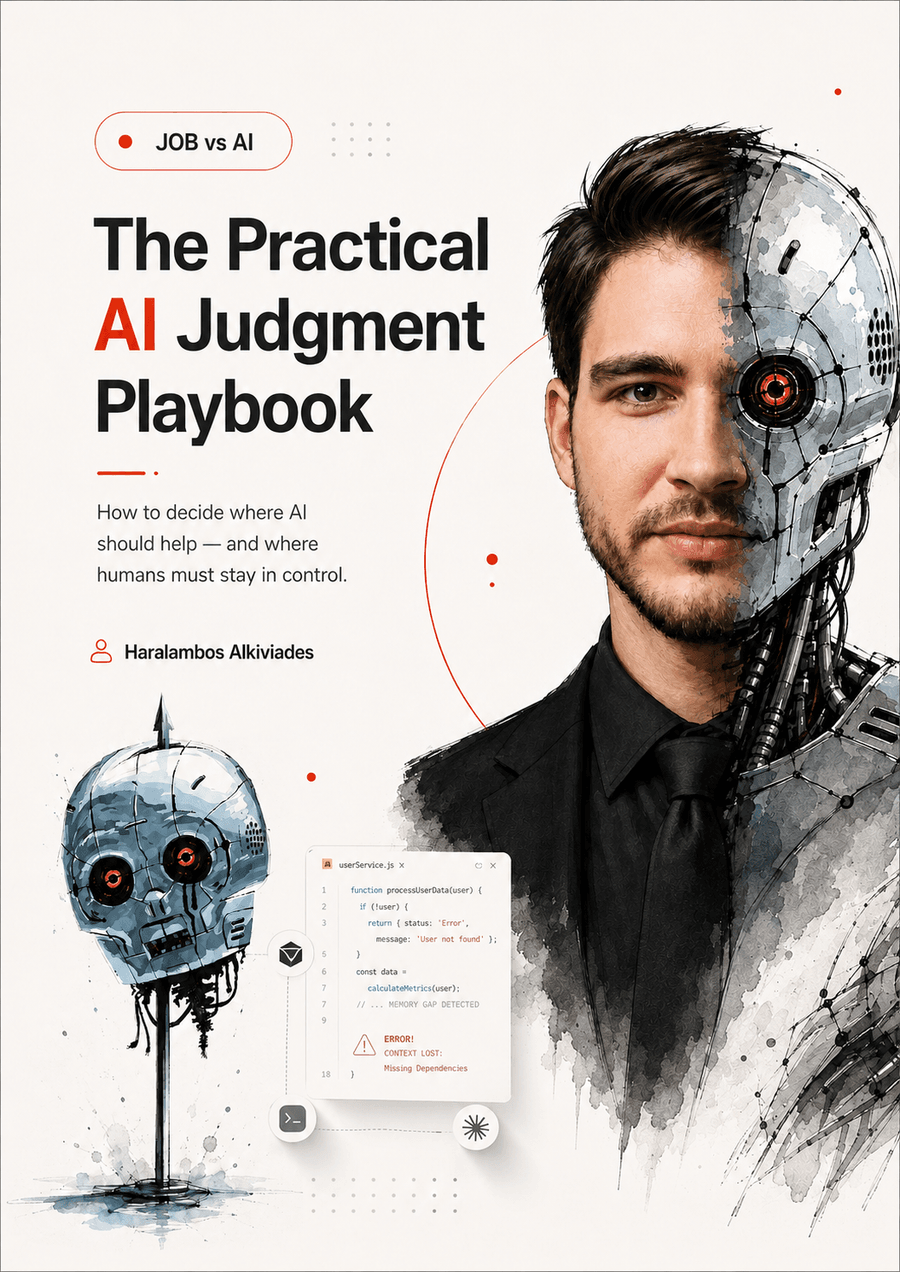
The Practical AI Judgment Playbook: Accounting
Six representative situations, the reasoning behind each lane, three agent blueprints, and the failure modes worth knowing before you trust an output.
Keep going
Other professions
The same structure, applied to different work.
Sales
Account Manager
The only profession in this series where a completely correct output can still be the thing that costs you the account.
Delivery
Project Manager
The profession whose actual deliverable is information other people act on - which makes it the one where faster reporting can quietly make the job worse.