
Problem solving
AI belongs inside the improvement loop
Continuous improvement has a shape. AI can make several of its steps much faster without changing where the loop is headed.
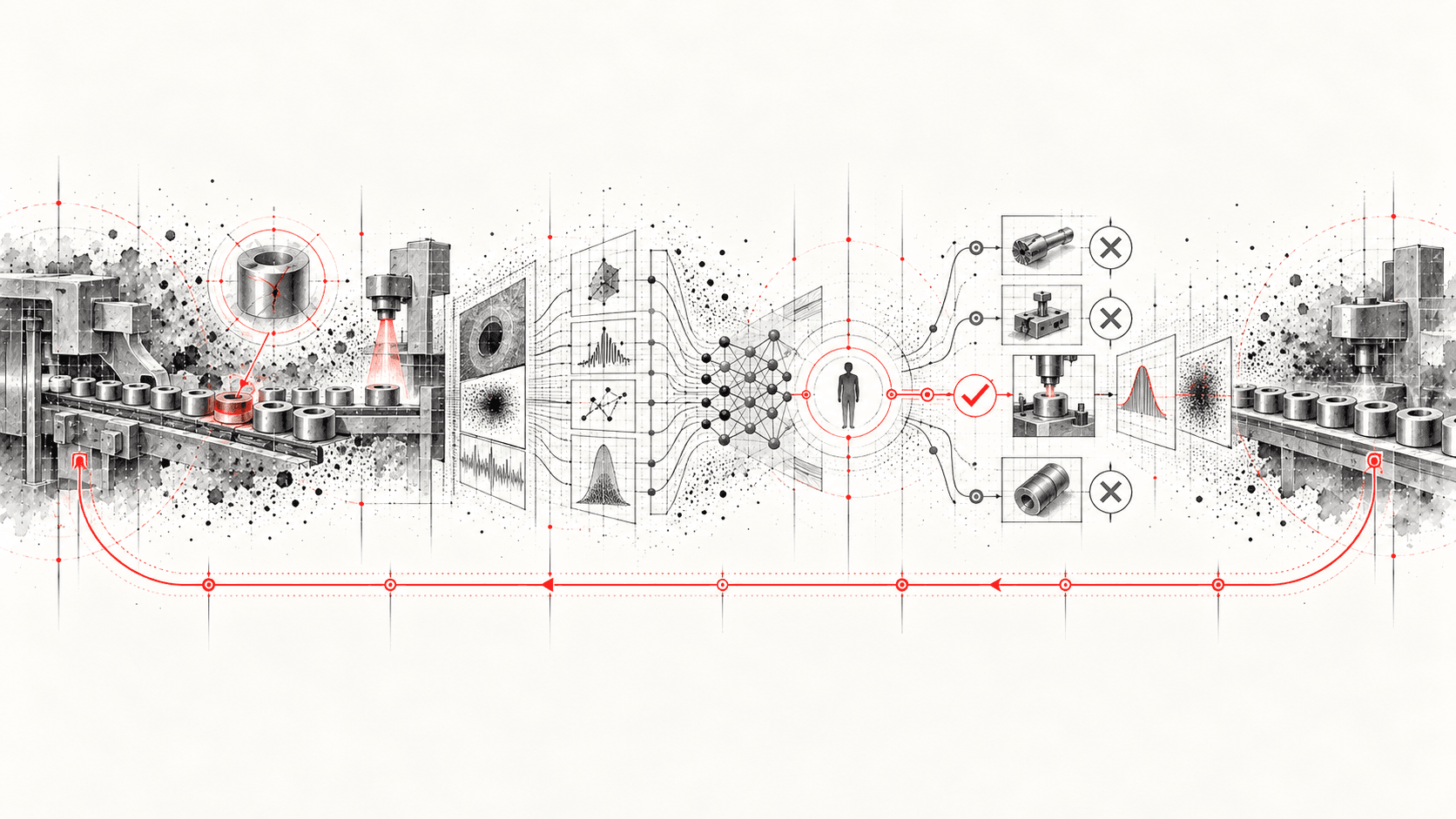
In manufacturing, improvement has a shape. You observe the current condition, state the problem precisely, collect evidence, analyse the causes, form a hypothesis, test a countermeasure, measure what happened, standardise what worked, and start again on whatever is now the biggest problem. The order matters, the steps are separable, and skipping one shows up later as a fix that does not hold.
I have worked a defect-reduction problem through a structured method of this kind, step by step, with each step documented before the next one started. What stays with me is not any individual finding. It is how much of the work was not analysis at all. It was making the situation legible: agreeing what the defect actually was, deciding which measurements represented it, and separating what we knew from what we had assumed.
That is the frame I use when people ask where AI fits into continuous improvement. It fits inside the loop, at particular steps, and it is genuinely useful there. It does not replace the loop, and that difference decides whether it helps.
The loop is the method, not the paperwork
A structured improvement method looks like documentation overhead, especially to anyone who has only seen one applied badly. The structure is doing something, though. Each step forces a commitment that can be checked later: this is the problem, this is the evidence, this is the cause we believe in, this is what we changed, this is what happened.
Those commitments are what make improvement cumulative instead of anecdotal. A fix with no recorded hypothesis cannot be distinguished from luck. A result with no baseline cannot be defended six months later when the problem comes back. The method keeps a factory honest about cause and effect, which is hard, because production is noisy and everybody has a theory.
The Toyota tradition puts weight on going to the place and looking at the work for the same reason. A description of a problem that arrives in a meeting has usually already been turned into a diagnosis by somebody.
Where AI helps, concretely
Several steps in that loop are mostly information work, and information work is where the current tools are strong. The honest list, from my own use:
- pulling scattered evidence into one place, out of logs, reports, spreadsheets and notes that were never meant to be read together;
- analysing data faster than anyone will do it by hand, including the dull statistics nobody gets round to;
- finding patterns across variables that a manual analysis would look at one at a time;
- proposing candidate causes, including the ones a team has stopped considering because it already has a favourite;
- drafting the experiment: what to change, what to hold constant, what to measure, how long to run it;
- writing up what happened in a form somebody else can read and repeat;
- comparing a result against previous attempts, the step most often skipped because the old records are awkward to find.
A model asked to criticise a problem statement will also ask about something obvious that everyone in the room had silently agreed to ignore, which is useful on its own. Taken together this is a substantial contribution. If gathering evidence, analysing it and writing it up each take a third less time, a team can run more cycles, and the number of cycles completed is close to the real determinant of how much a process improves.
What the loop still asks of a person
The steps AI accelerates are the ones with a clear input and a clear output. The steps that decide whether the loop is pointed in the right direction are different, and they stay human.
Framing comes first. A precise analysis of the wrong problem is one of the more expensive things a team can produce, and nothing in the data announces that the frame is wrong. That judgment comes from knowing the process, the product and what the customer experiences.
Then there is the question of whether the data represents reality. Measurement systems drift, samples get taken where it is convenient rather than where it matters, and the definition of a defect is often less agreed than everybody assumes. A model analyses what it is given and holds no opinion about whether what it was given is true.
Choosing among countermeasures is an act of accountability rather than a calculation. Most of them cost something: cycle time, capacity, complexity, an operator's attention, another department's workload. The person choosing has to be able to defend the trade.
Reading the result is similar. A change can be statistically real and practically irrelevant, or it can sit inside the noise and still be worth keeping because it removes a source of variation somebody has been babysitting. That reading comes from being close to the work.
Standardising is the last judgment and the largest. It means everybody on every shift does it this way now, and it commits the organisation to training, documentation and supervision. It is not a data question at all.
Faster is not the same as better directed
The risk I take seriously is not that AI produces a wrong analysis. It is that it produces a plausible analysis quickly enough that nobody examines the framing. A generated cause-and-effect diagram looks like the output of a team that thought hard, and the speed compresses the visible effort, which is exactly when to slow down, because the loop's value depends on its commitments being real.
So I keep the sequence the method already implies. A person states the problem and decides what evidence would settle it. AI helps gather and analyse. A person decides which cause to act on and what to change. AI helps design and document the test. A person judges the result, decides whether to standardise, and owns what follows. That leaves AI doing a great deal of the work and none of the deciding, which is the division of labour a good engineer already keeps with a junior colleague or with a measurement system.
Standardising is the step that gets skipped
Teams enjoy the analysis and the experiment. Standardisation is administrative, so it waits, and while it waits the process drifts back. Six months later somebody opens a new project on a problem that had already been solved once. A structured method exists partly to force that final step, and faster analysis is no substitute for it.
AI helps here too, by making the documentation cheap: the updated work instruction, the revised check, the record of why the change was made. It is the least interesting use and probably the one with the largest durable gain.
What the extra speed is for
Continuous improvement is an operating discipline rather than a project. It works because the same small cycle runs again and again on whatever is now the biggest obstacle, and because each turn of it is honest about cause and effect.
AI can make several steps of that cycle faster, and faster cycles compound. It has no view on whether the cycle is aimed at the right problem, whether the numbers describe the plant, or whether the organisation will keep the change. Those judgments decide whether all the extra speed is going anywhere.